

Frequently Asked Questions-
Westport Flood Protection Scheme
Frequently Asked Questions (FAQs)
September 2026
Westport Flood Protection Scheme reset
Special Consultative Procedure Frequently Asked Questions (FAQs) as at September 2026
Note, the FAQs below are a sample of the full document that can be downloaded here.
What is the Westport Flood Protection Scheme?
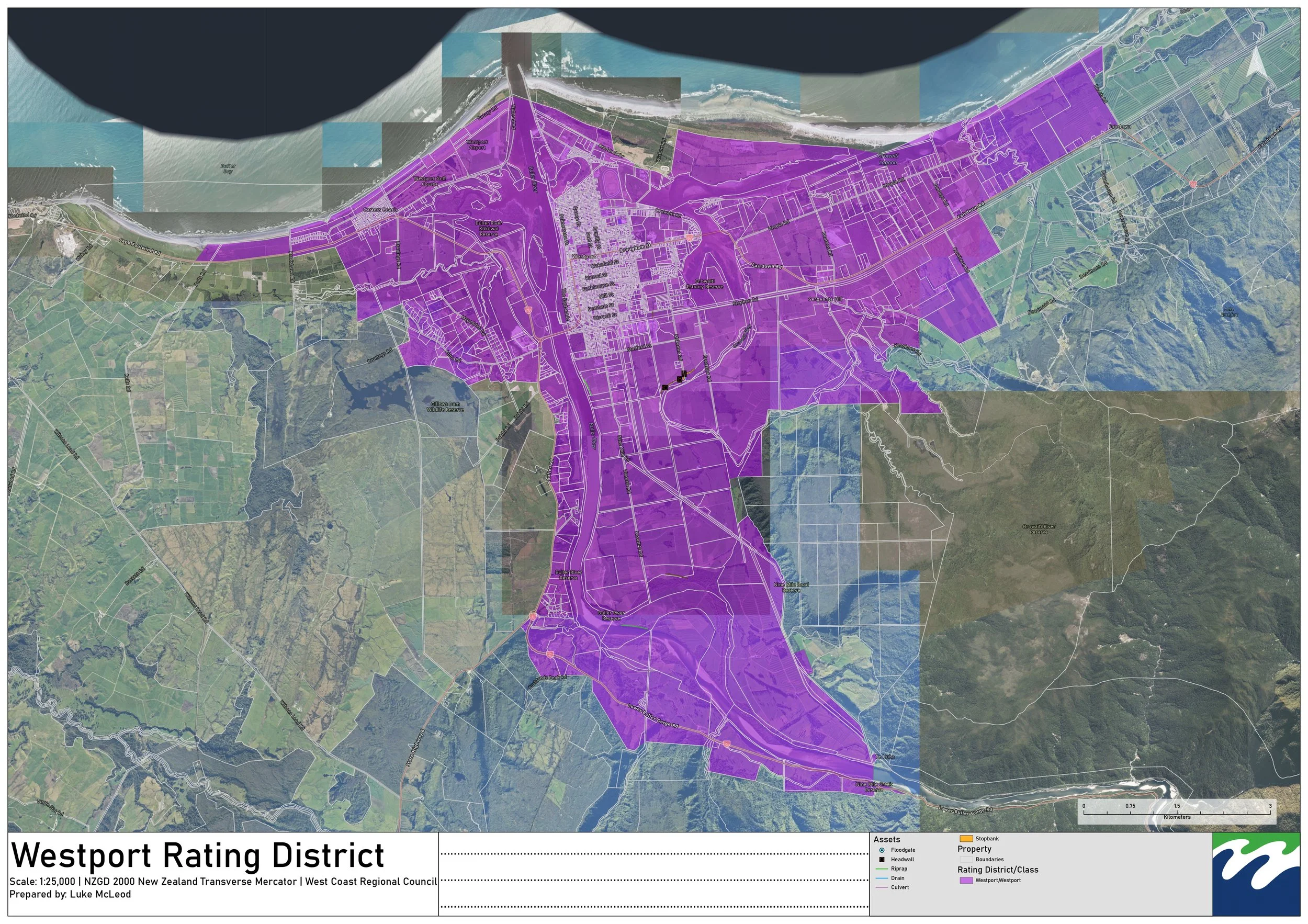
The Westport Flood Protection Scheme (WFPS) is a combination of structures such as earth stopbanks, ‘planter-box’ floodwalls, concrete floodwalls, and portable flood barriers around Westport that are designed to reduce the impact of flooding associated with the Buller and Orowaiti rivers. The total length of the main protection scheme for Westport is over 16km.
The WFPS is being delivered by the West Coast Regional Council and is part funded by the government via the Resilient Westport programme of work.
Scheme reset
What is the Westport Flood Protection Scheme (WFPS) reset?
In the last two years, detailed above and below-ground investigative work, flood modelling and design work have been carried out on the planned WFPS. The key outcome of this work was gaining the understanding that the scheme as originally proposed was not affordable or realistically deliverable. The project team decided a reset of the scheme was required.
They carried out an extensive review, resulting in the proposed reset options being consulted on, to deliver a more affordable solution, that still achieves a significant reduction in the flood hazard.
The engineers, project manager, and other experts examined in detail a range of scenarios to deliver a more affordable scheme, but protecting the same number of properties
Each scenario required an examination of the level of flood protection, revised hydraulic modelling to assess flood impacts, with and without the proposed scheme, its performance in large flood events, stopbank alignment, technical solutions (seepage, ground conditions, material) and sequencing (maximising the timing of work for efficiency).
From these, they arrived at options for the community to consider to take the scheme forward.
What are the options for the reset?
Two options are being proposed for consultation.
Option One - Core protection scheme
The main Westport Flood Protection Scheme built to:
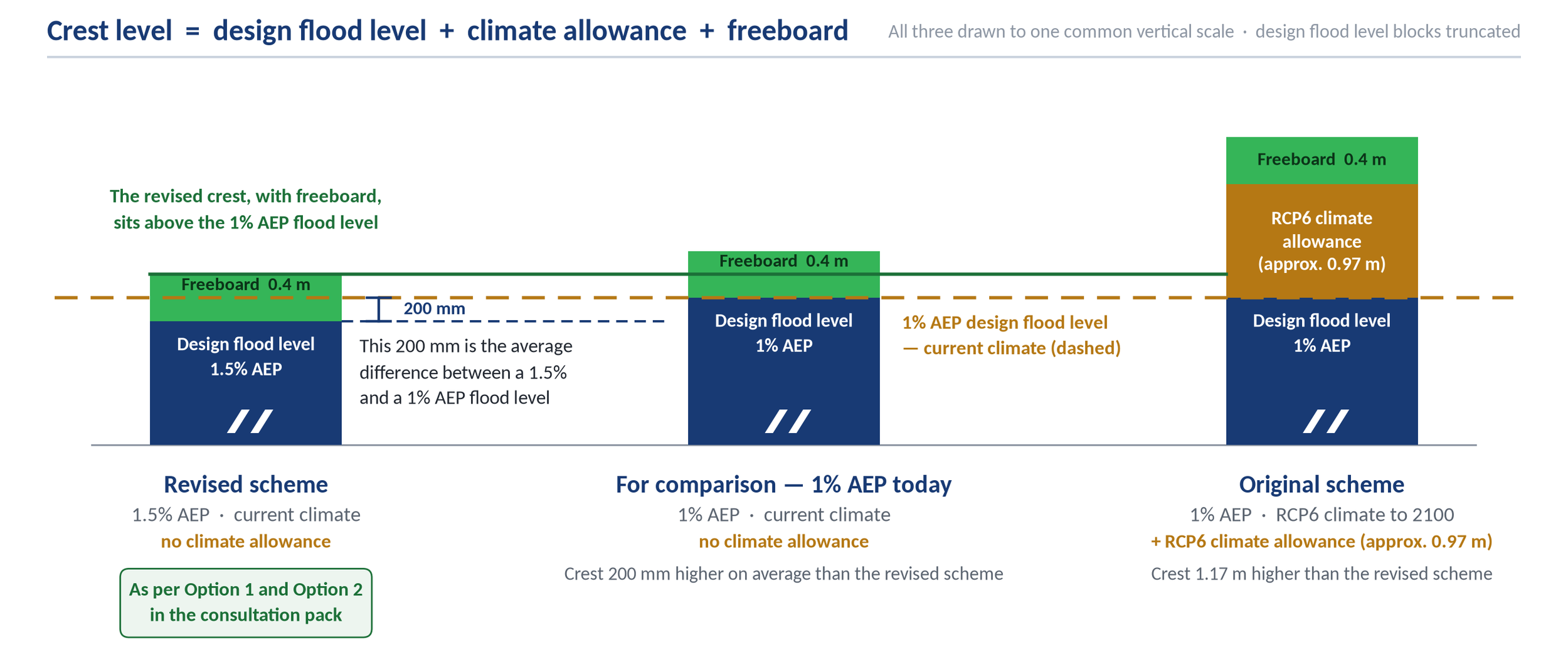
1.5% AEP (Annual Exceedance Probability) protection level,
based on the current climate
400mm of freeboard (additional height to allow for uncertainties)
The revised alignment of the Carters Beach stopbank (built to a 1.5% AEP, plus 300mm freeboard).
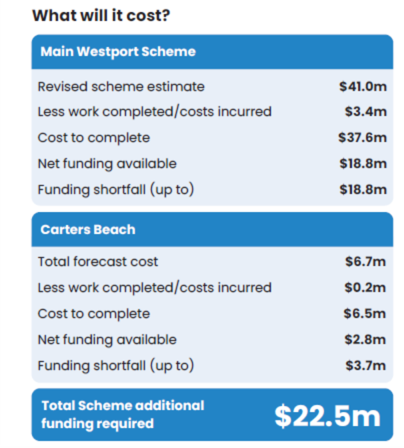
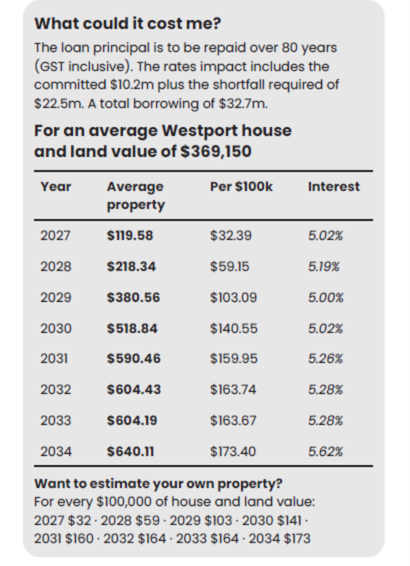
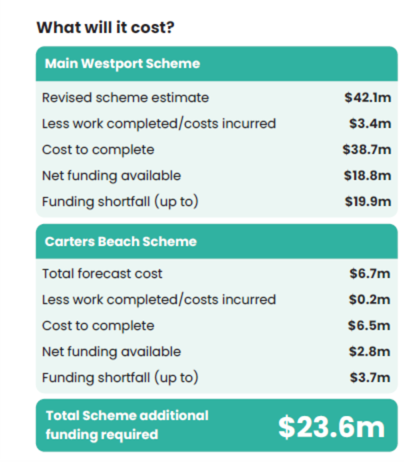
Total additional scheme borrowing required is $22.5m, in addition to $10.2m already committed. Total borrowing up to $32.7m*.
Option Two - Optimised hybrid scheme (preferred option)
The Optimised Hybrid Scheme provides an extension of Option One for the main Westport Flood Protection scheme, and Carters Beach.
1.5% AEP (Annual Exceedance Probability) protection level
based on the current climate
400mm of freeboard
The revised alignment of the Carters Beach stopbank (built to a 1.5% AEP, plus 300mm freeboard).
The difference involves constructing some short sections of stopbank in a way that they can be raised more cost-effectively in the future if required.
Total additional scheme borrowing required is $23.6m, in addition to $10.2m already committed. Total borrowing up to $33.8m*.
Both options provide a level of protection equivalent to a 1 in 67-year flood and would protect Westport from a flood comparable to the July 2021 event.
*See the SCP consultation document for a detailed break down of costs and rates implications.
What was proposed in the original scheme?
The original scheme (high protection) proposed to provide 1 in 100-year level of flood protection.
The level of freeboard (extra height allowance for uncertainty) was 600mm but this has been reduced due to enhanced computer modelling. RCP6 (climate allowance) was factored into the original design.
This scheme would now cost around $70m to deliver.
(See Technical terms further below for definitions of these terms.)
Why has the cost changed so much?
The scheme that was applied for in 2021 and 2022 is very different from the scheme that is now being designed and priced. The early figures came from concept work. A possible alignment had been drawn at a high level, earthwork volumes were estimated from a single point along the proposed alignment, a flat allowance was added for unknowns, and ground investigation, consenting, and risk allowances were not included, but are real-world delivery costs.
The updated scheme costs come from more detailed cost estimates using a peer-reviewed preliminary design off three-dimensional models. Setting the two side by side, this is more than just a price increase.
Five things changed in the scheme itself as the design work was done:
The stopbanks had to get bigger. Geotechnical work and engineering review required flatter, more stable sides, requiring a large increase in stopbank material.
Seepage control had to be added. An independent review found that water moving underneath and through the banks in a flood (seepage) had not been allowed for. The concept design never contemplated this, and seepage control is now the single largest driver of both cost and remaining risk.
The scheme had to get longer. Detailed flood modelling showed protection had to extend about 700 metres further up the Buller River, alignments shifted in places, and extra work was needed in a number of places. A flood protection system works in an integrated manner, so these were not optional.
The materials changed. Locally won river gravel was proposed for stopbank material but is not adequate to prevent seepage, so more engineered (and costly) material is required.
The real costs of delivery came in. Consenting, land access, ground investigation, independent reviews, safety in design, and a measured allowance for risk are all costed now with greater accuracy. These costs weren’t included in initial estimates yet are real delivery costs.
The WFPS funding situation in a nutshell:
Central Government has committed $15.6 million to physical flood protection for Westport. The 2021 consultation resulted in the West Coast Regional Council committing $10.2 million to the scheme – totalling around $26 million in funding for the main scheme (excluding Carters Beach and Snodgrass Road).
The figures being consulted on include Carters Beach as it is considered integral to the scheme but was not granted funding from Central Government.
The project team is advocating for additional government funding and has applied to the Regional Infrastructure Fund (RIF).
There is a pledge from several local businesses of around $1.8 million, which is intended to be initially directed to structural works at Carters Beach due to the level of urgency. The WCRC is committed to delivering flood protection for Snodgrass Road in the future.
What about maintenance and ongoing costs?
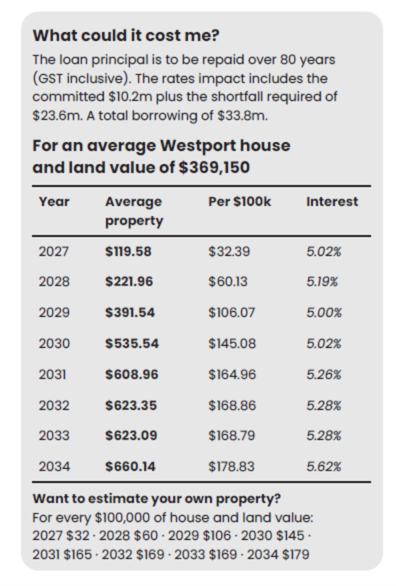
WCRC will maintain the stopbanks and the cost will be included in rates. In 2027, that would be $45.30 annually (based on a property valued at $369,000), going up to $78.70 by 2034.
How long could the scheme take to build?
The revised scheme plans to see completion of construction of the main flood protection scheme and Carters Beach by the end of 2029.
Flood protection projects of comparable scale and size can realistically take 5 to 10 years to complete. The planning and investigative work we have done to date is extensive so we think we can deliver the balance of the work in next three years.
What are the design and construction challenges?
The team’s investigations have confirmed that many sections of the flood scheme face technical and constructability challenges, including seepage, stability, constrained corridors (narrow areas near homes or roads), utilities and contaminated land.
Work will continue to resolve these issues because of their importance. Key decisions are still being worked through on matters such as seepage treatment, floodwall types and fill sources, because these have material implications for affordability and buildability.
What other option was considered?
Another option (Future climate protection) was considered in detail but has been set aside based on affordability. This option involved the main flood scheme and Carters Beach being built to the same 1.5% AEP (Annual Exceedance Probability) protection level as Option One and Option Two, but with additional stopbank height to address forecast changes in climate over the next 30 years.
This option would involve stopbanks approximately 0.3 metres higher than the other options but because it cost about $8.8m more than Option One and $7.7m more than Option Two, it was considered too high an additional cost for the community to meet and was set aside as an Other Option considered.
What is the plan for Carters Beach and Snodgrass Road?
The WCRC intends to deliver flood protection for these communities.
Flood protection at these locations was not funded by central government, despite Carters Beach being including in the Kawatiri Business Case request for co-funding.
This Special Consultative Procedure includes funding for Carters Beach, as it has interdependencies with the main scheme and must be delivered alongside it.
The flood modelling shows that building the Westport stopbanks will change how water moves in the Lower Buller, affecting Carters Beach. Consent for the Westport works is unlikely to be granted while that remains unaddressed, so Carters Beach is pivotal to the wider scheme progressing. Carters Beach protection is costed at about $6.5 million, of which about $2.8 million of co-funding has been identified, meaning Westport ratepayers will be asked to underwrite up to $3.7m.
Snodgrass Road is not being left out. The West Coast Regional Council is committed to providing flood protection for Snodgrass Road and the plan is that it will be delivered later. It is not part of the current consultation because there are no significant changes to the plan for Snodgrass Road and it carries no new rates proposition. It will be consulted on with the community in the future.
What does the level of proposed flood protection look like under the options being consulted on?
The graphic below demonstrates the flood protection offered by the consultation options (1.5% AEP), a 1% AEP flood and the original (high protection) scheme.
What does the flood modelling show in the case of a 1:67-year flood with the revised flood protection?
The modelling shows that Westport would be largely protected under the revised scheme.
Consultation information
What is a Special Consultative Procedure?
A Special Consultative Procedure (SCP) is a highly structured, formal public consultation process governed by Section 83 of the New Zealand Local Government Act 2002.
The West Coast Regional Council is legally required to trigger an SCP under specific conditions outlined in their Long-term Plan and legislation. In this case, the changes proposed represent an amendment to Council’s current Long-Term Plan (LTP) 2024-2034.
Why do a Special Consultative Procedure?
The changes being proposed mean considering:
The impact on rates arising from the increased cost of the scheme
Changes to the level of flood protection to be delivered for Westport
Funding flood protection for Carters Beach.
These represent a significant variation from what was included in the West Coast Regional Council’s Long-Term Plan (2024-2034) and what was consulted on with the community in 2021. Therefore, additional consultation is required.
A Special Consultative Procedure is triggered under the West Coast Regional Council’s Significance and Engagement Policy.
What are the consultation dates?
Consultation runs between Monday 21 September to 5pm 21 October 2026.
How can I submit?
The main way to submit is online via www.wcrc.govt.nz/community/consultation
Those who prefer more traditional methods of submitting can collect and drop off forms at:
Sue Thomson Casey Memorial Library (87-89 Palmerston Street, Westport)
Buller District Council’s Westport Service Centre (6-8 Brougham Street, Westport)
Resilient Westport office (147 Palmerston Street, Westport) - During community drop-in sessions.
Copies of the Special Consultative Procedure document, survey forms and sets of Frequently Asked Questions will be available to read or take away.
Where can I find out more?
West Coast Regional Council website: www.wcrc.govt.nz/community/consultation
Community drop-in sessions on Wednesdays between 11am and 1pm at 147 Palmerston Street, Westport.
What is the process once the Special Consultative Procedure is complete?
The results of the consultation will be analysed in October and collated into a report for the West Coast Regional Council and for the Westport Rating District Joint Committee.
Public hearings for those who to speak to their submissions will be held on 27 October 2026 (11am-3pm approx). They will be held in Westport.
The results of the Special Consultative Procedure will be placed before the full West Coast Regional Council at its December 2026 meeting.
Why do a Special Consultative Procedure now, rather than wait for the next Long-Term Plan consultation?
There is some urgency around next steps for the WFPS that require a mandate from the community and decision-makers in order to progress. There are significant implications for the community in the revised scheme proposal including additional rate requirements. The community needs to be consulted on these changes before the next major phase of construction gets underway.
Consultation on the Long-term Plan 2027-37 is not due to commence until 2027 and waiting until this time will mean the Project is delayed. Undertaking a Special Consultative Procedure provides the opportunity for the WFPS to make use of the coming summer construction period.Technical terms
What is seepage?
Seepage is the slow escape of water through or under a stopbank during high river levels. While minor, controlled seepage helps relieve internal water pressure, excessive or uncontrolled seepage creates internal erosion, piping, and structural instability that can lead to the collapse of the flood defence.
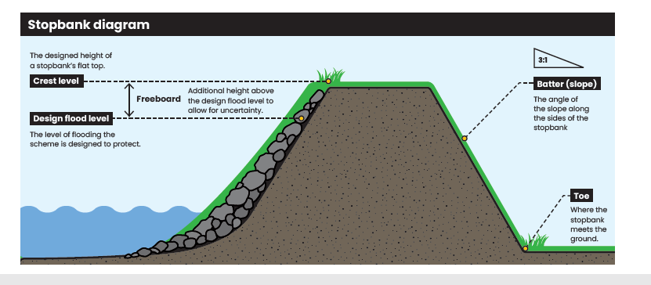
What is crest level?
Crest level is the designed height of a stopbank’s flat top. This can vary in width according to the dimensions of the stopbank.
What is batter?
Batter in a stopbank refers to the angle of the slope along the sides. It stablilises the earthen wall. A stopbank with a 2:1 ratio is steeper than a 3:1 slope, which are easier to maintain and carry less of a slumping risk. The new design proposes using 3:1 batters where possible.
What is the toe?
The toe of a stopbank is the bottom edge where it meets the ground.
What is level of service?
Level of service relates to the way flood protection works are designed and constructed and can include the height of the flood you are protecting against, future climate provisioning (how much extra height we build into the scheme to allow for future climate change), and freeboard (additional stopbank height to address uncertainties).
What does ARI mean?
ARI stands for annual recurrence interval (ARI) which is sometimes also known as ‘return period’. It is the average time period between floods of a certain size. For example, a 50-year ARI event would on average happen every 50 years.
What does AEP mean?
AEP stands for annual exceedance probability (AEP) which is the probability of an event occurring in any given year.
So a 1% AEP means there is a 1% chance in of the event occurring in any given year of the event occurring. This means that on average 1 event of this size will occur every 100 years.
Therefore, 1% AEP is equal to a 100-year annual recurrence interval, a 2% AEP is a 50-year ARI, and a 10% AEP is a 10-year ARI.
What annual recurrence interval does a 1.5% AEP have?
A 1.5% AEP has a 1-in-67 chance of a specific flood or rainfall event occurring or being exceeded in any given year.
What is freeboard?
Freeboard is additional stopbank height to address uncertainties. It is extra height built on top of the design flood level as a safety margin.
It is usually measured in millimetres and the higher the level of freeboard the greater contingency for ‘over design’ events (events that exceed the design flood level).
The original Westport scheme included a freeboard provision of 600mm. That will now be 400mm. The lower level is supported by improved computer modelling.
What is a 30-year climate provision?
A 30-year climate provision generally refers to planning at least 30 years into the future to identify, manage, and reduce community and infrastructure risks from climate-related natural hazards, such as extreme weather events and sea level rise.
What does RCP mean?
RCP stands for Representative Concentration Pathways (RCP). These are climate change scenarios to project future greenhouse gas concentrations. RCP6 reflects a scenario where emissions continue to rise but there is some stabilisation by 2100. RCP6 was factored into the original design.
Background on the flood protection work
When did the project team get started?
While floods that gave rise to the flood protection project occurred in 2021 and 2022, it took several years for the project to be established and secure funding. Therefore, the project has effectively been operating for around 2 and a half years (since early 2024).
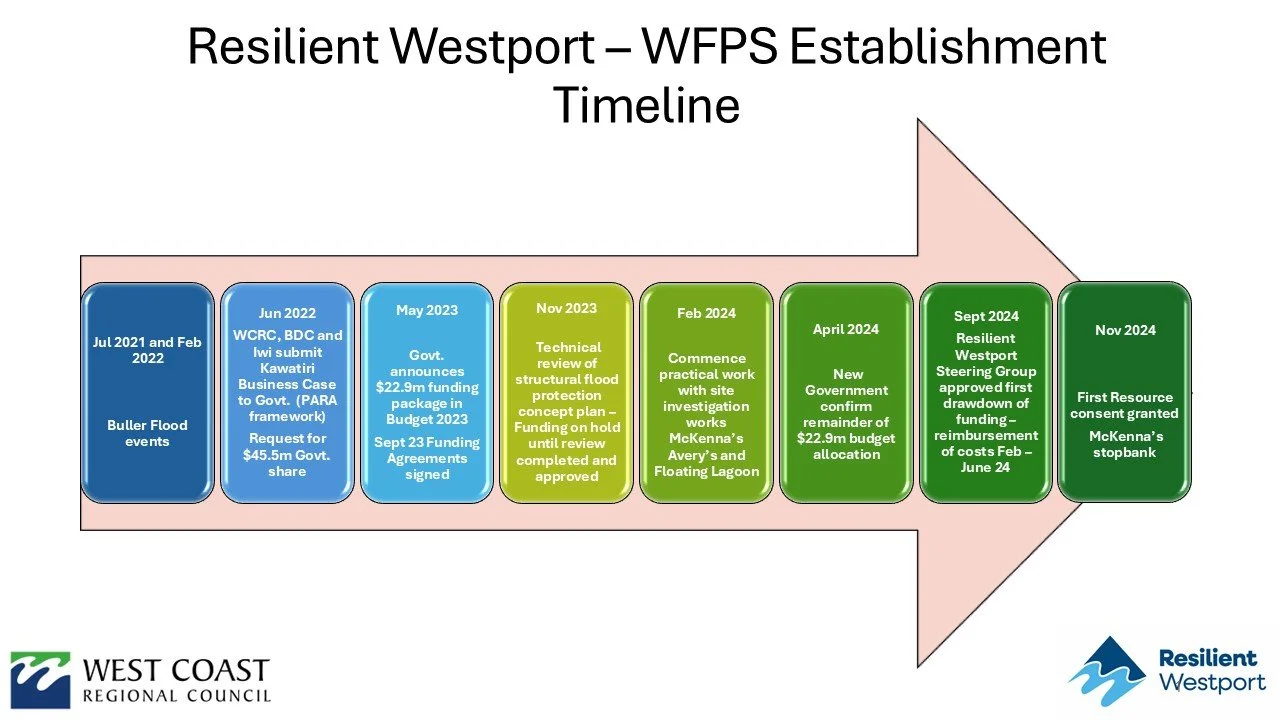
What was the project establishment timeline?
After the floods of 2021 and 2022, a business case was put to government to co-fund flood resilience for Westport.
In May 2023, government announced a $22.9 million funding package (Resilient Westport). In September 2023, the Department of Internal Affairs approved the $15.6 million funding for flood protection.
A technical review of the structural concept for the scheme, commissioned by the Department of Internal Affairs, was carried out between November 2023 and February 2024. Concerns raised there were addressed and/or mitigated.
The 2022 business case was a concept design. Since that time, the project has followed standard engineering practice to take the scheme from concept design to preliminary and in some cases final design. This, informed by additional information geotechnical information and other investigations, has led to the revision of the scheme.
What Resource Consent Applications are pending?
There are Resource Consent applications lodged with consenting authorities for the Floating Lagoon stopbank, as well as a joint application for Carters Beach and Upper Buller. We continue to work with the consenting authorities to facilitate those consents. Those consents have been on hold in recent times whilst we seek the mandate of the community and local governance to continue the scheme under new settings. Once we have the two options to consult on, these will be progressed with the consenting authorities.

Option One
Option Two
-
We estimate there are 83 parcels of land directly affected by the planned floodwalls.
This includes private, Council (BDC), and Crown/reserve land. A comprehensive Land Access Strategy is being developed to help manage the process.
The goal is to establish trust and transparency with landowners, secure legally sound access rights and property agreements, minimise project delays, ensure environmental, cultural, and community considerations are respected and build long-term relationships that support future access needs for maintenance.
The strategy the team has put together ensures a co-ordinated approach to engaging with landowners, to ensure they are guided through the process with as much transparency as possible.
How many people have already been spoken to in relation to land access?
The WFPS team has been dealing with landowners throughout the scheme in relation to access to land, for geotechnical drilling for example.
Where we think a landowner might reasonably be affected by a planned stopbank, we have had preliminary conversations with them. To date, this includes people and groups in and around Carters Beach, as well as Upper Buller, Upper Orowaiti and Floating Lagoon, and those in the vicinity of the Avery’s stopbank.
We will continue to do so once we get closer to building in specific areas. This will happen more as the designs progress and more specific access requirements are known. We can’t finalise agreements until we have final designs.
Why haven’t more land access agreement been reached?
We have access agreements in place for the McKenna’s stopbank area, three License to Occupy agreements with Buller District Council and the O’Conor Home site, as these have been required to carry out work.
For the remaining parcels, the project team has not yet sought to finalise access agreements, as detailed designs and alignments are still being developed.
Until alignments, design footprints, construction requirements and long-term maintenance access requirements are sufficiently defined, we aren’t in a position to confirm the exact land access requirements with affected landowners.
-
What external skills are required to help deliver the project?
A large number of skilled professionals are required to deliver a project of this scale, technical complexity, and regulatory burden.
These include: geotechnical drilling and investigation; civil, structural and geotechnical engineering design (across concept, preliminary, detailed and final design stages); hydraulic and flood modelling; ecological investigations; contaminated land and environmental site investigation; archaeological and heritage assessment; resource consent preparation and planning; independent peer review of designs and technical reports; quantity surveying and cost estimation; land access and property support; communications and community engagement; and project management support.
Many of these specialist inputs are required by regulation or by the conditions of our funding arrangements — they are not discretionary. Independent peer review, in particular, is a deliberate quality assurance measure to ensure the public can have confidence in the technical rigour of the scheme's design.
-
Why not just dredge the river some more?
It is considered that dredging would not contribute much to flood risk mitigation in Westport.
The Buller River has the power, in large flood events, to determine its own bed levels and bed profile and will scour and deposit bed material to suit its very high sediment transport capacity.
The Buller River channel, along its lower reaches and out to the river mouth bar, has been dredged for harbour development and maintenance purposes for many years. Rock tide walls have been used to confine flows in the main channel. This experience has indicated this has not had much effect on the bar or on channel depths.
Dredging/gravel extraction is costly and without commercial demand for the aggregate, dredging would come at significant ongoing cost.
The benefits of gravel extraction are also not reliable, with even small river floods having the ability to replace extracted gravel overnight.
-
Why not consider the ‘Orowaiti cut’?
We continually get asked why the ‘overflow’ cut is not being done.
This option was put forward for consideration by the technical Advisory Group that advised Buller Flood Recovery in the immediate post-flood environment. We have looked closely at all the advice on this proposed solution. The proposed cut was suggested as best located where the Orowaiti Estuary bends to the east. The cut was envisaged as allowing flow to go directly out to the sea, through the spit, thereby preventing higher than wanted ponding of upriver floodwater flows.
The advice received was that the long length of a cut between the estuary and the current coastline, and the lack of hydraulic gradient at this location, would make any overflow cut option inefficient.
The cut would have to be wide and shallow to have sufficient capacity while still fitting the level limitations of the estuary and sea.
Advice taken in 2022 is that the cost just to excavate the Cut would be in the region of $5 million.
Maintenance of the cut would need to be relatively constant due to inevitable silt and sediment build-up and would involve significant cost.
The coastline has been growing since the early 1900’s and is expected to continue to do so. This means it would become harder and harder to keep the Cut open over time.
Sea level rise is also expected to continue to increase, further potentially threatening the efficacy of a Cut.
An opening in this area would significantly increase the risk of sea surge and tsunami hazards to residents of Westport. Our experts believe it would enable the propagation of damaging coastal waves through the lower Orowaiti area during major sea storms.
You can watch the video of Land, Sea, River Consulting river engineer Matt Gardner as he answers questions about the Orowaiti Cut and why it was first considered, then ruled out. Matt has extensive experience on the West Coast advising on river modelling. Go to about 26 and a half minutes to see this section.
https://youtu.be/lwdh_FUzQ8M?feature=shared